
How Eversight modernized 75 years of mission for the way people actually find it
The mission was clear. The website wasn't.
Eversight is one of the largest eye banks in the United States. For more than 75 years they have restored sight through corneal transplantation, research, education, and an active global program. Their audiences include corneal surgeons and ophthalmology fellows, donor families and recipients, researchers, medical professionals working in global health, and the broader community of people who care about the mission. By 2025, the website meant to serve them all had not kept pace with the organization behind it.
Nonprofit websites grow the way nonprofits grow: by addition. New programs add new sections. New campaigns add new pages. New leadership adds new priorities. Over time, theme upgrades stack on top of older theme work, page builders get swapped, redirects get bolted on, and the database accumulates years of layered customization that nobody on the current team installed. The Eversight site had been through several of these cycles. The most recent version was anchored by Cornerstone, a Wordpress page builder that structured content in ways that made the site difficult to maintain and effectively impossible to migrate cleanly with off-the-shelf tooling.
Their audiences felt the consequences. Surgeons looking for professional education had to fill out a form every time they wanted to access the same kind of content. Mobile users following a marketing link from social ended up stranded on subpages they could not navigate back from. Search was unreliable. Image sizes were inconsistent. Color combinations failed contrast checks. Different program areas had developed their own visual conventions over the years, so a visitor moving between Research and Global Vision and Eversight Academy could be forgiven for wondering whether they were on the same site.
Most consequentially, the donor tributes, stories honoring the people whose gifts of sight had changed other lives, were buried three clicks deep. Eversight explained that this had been deliberate. For most of the organization's history, the work involved a level of sensitivity that made publicizing donor stories feel inappropriate. By 2025, the community and the perspectives on donor story publicity had changed. The site had not.
By the spring of 2025, Brand Strategy & Communications Director Brenna Wheeler knew it was time. She brought in Lake One to migrate Eversight from WordPress to HubSpot Content Hub ( a HubSpot for Nonprofits solution), modernize the brand experience, and rebuild the digital foundation for the next decade of the organization's work.
How we aligned on what modernization meant
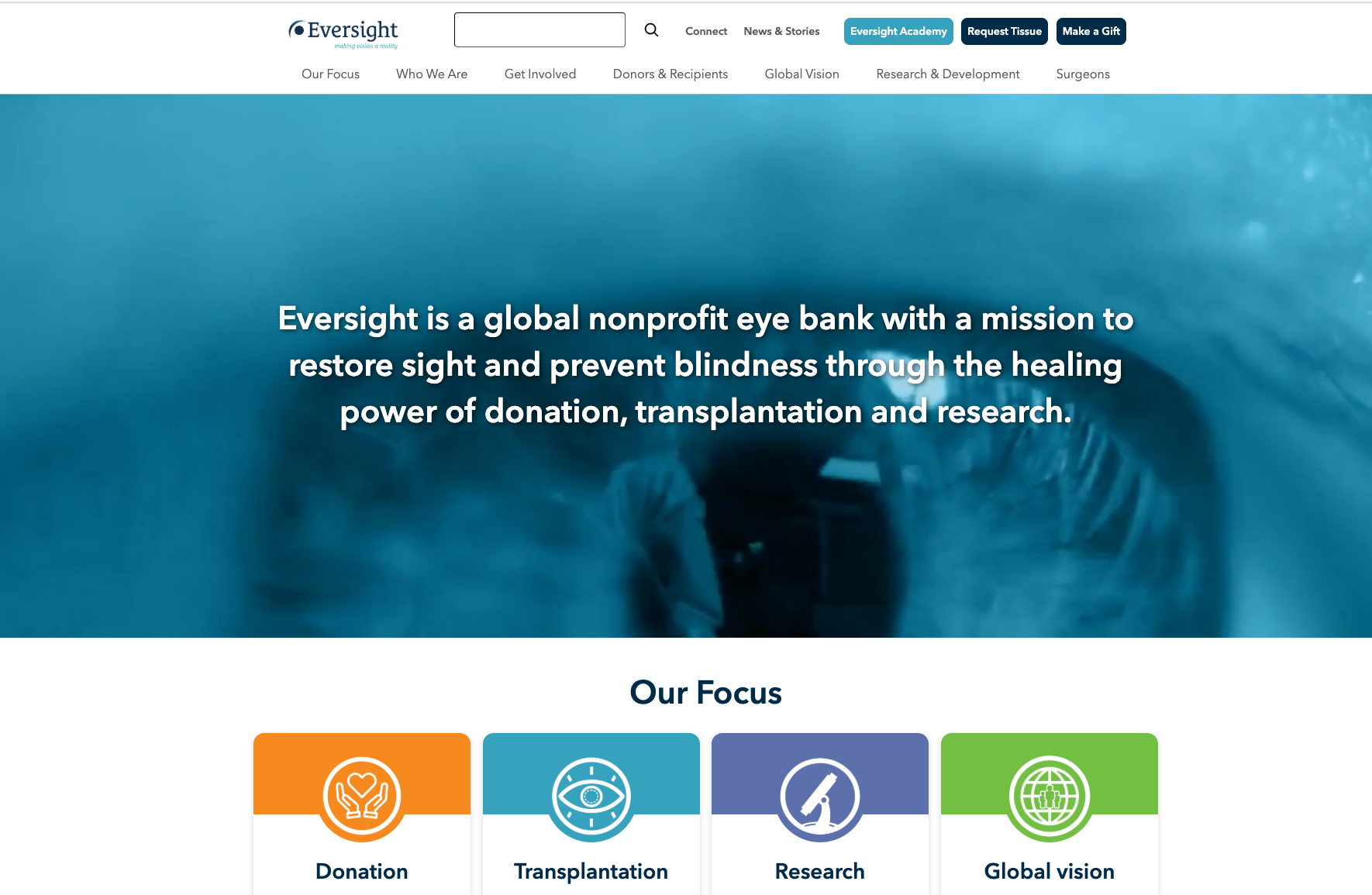
Lake One opened the kickoff by asking what modernization meant to the Eversight team. They answered with wayfinding. A search that worked. Mobile that worked. Related content that surfaced where it belonged. Donor tributes that were findable rather than hidden. The answer framed the project. The brand would look familiar. The site would behave differently.
Pillar one: how the site behaves
Before any content moved, Lake One audited every page on the existing site, organized not by section but by audience and purpose. The audit set a content reduction target of 30 to 40 percent. Not because content was unimportant, but because most of it had been written for a moment that had passed. Older program pages still ranked for searches no one was running anymore. Event recap blogs sat in the news index but were never linked from the landing pages that promoted those events. Content that did not earn its place in the new architecture was pruned with intention, redirected to its closest living relative, and tracked through Google Search Console so no incoming links were lost.
With the content set defined, Lake One moved the surviving pages and archives. Standard WordPress-to-HubSpot import tooling could not parse Eversight's content cleanly. Years of pages, blog posts, and tribute archives sat in database tables organized for the page builders rather than for portability. Lake One built an API-driven migration instead. Custom scripts pulled content out of the Cornerstone tables, normalized it, mapped it to the new HubSpot template structure, and pushed it back in through the HubSpot Content API. More than 600 pages and several years of blog and tribute history migrated.
In its place, a modular structure was built around how Eversight's audiences actually navigate. Donor families and recipients share an entry point but want different things. Corneal surgeons, researchers, and global program partners each have a path designed for them. The Young Physicians Group page, which had been one of the most visible disconnections in the old site, became the model. It now surfaces the post-event recap blogs that the communications team had been writing for years but had no way to feature, using a related-content module that pulls the most recent relevant posts onto the page that promoted the events.
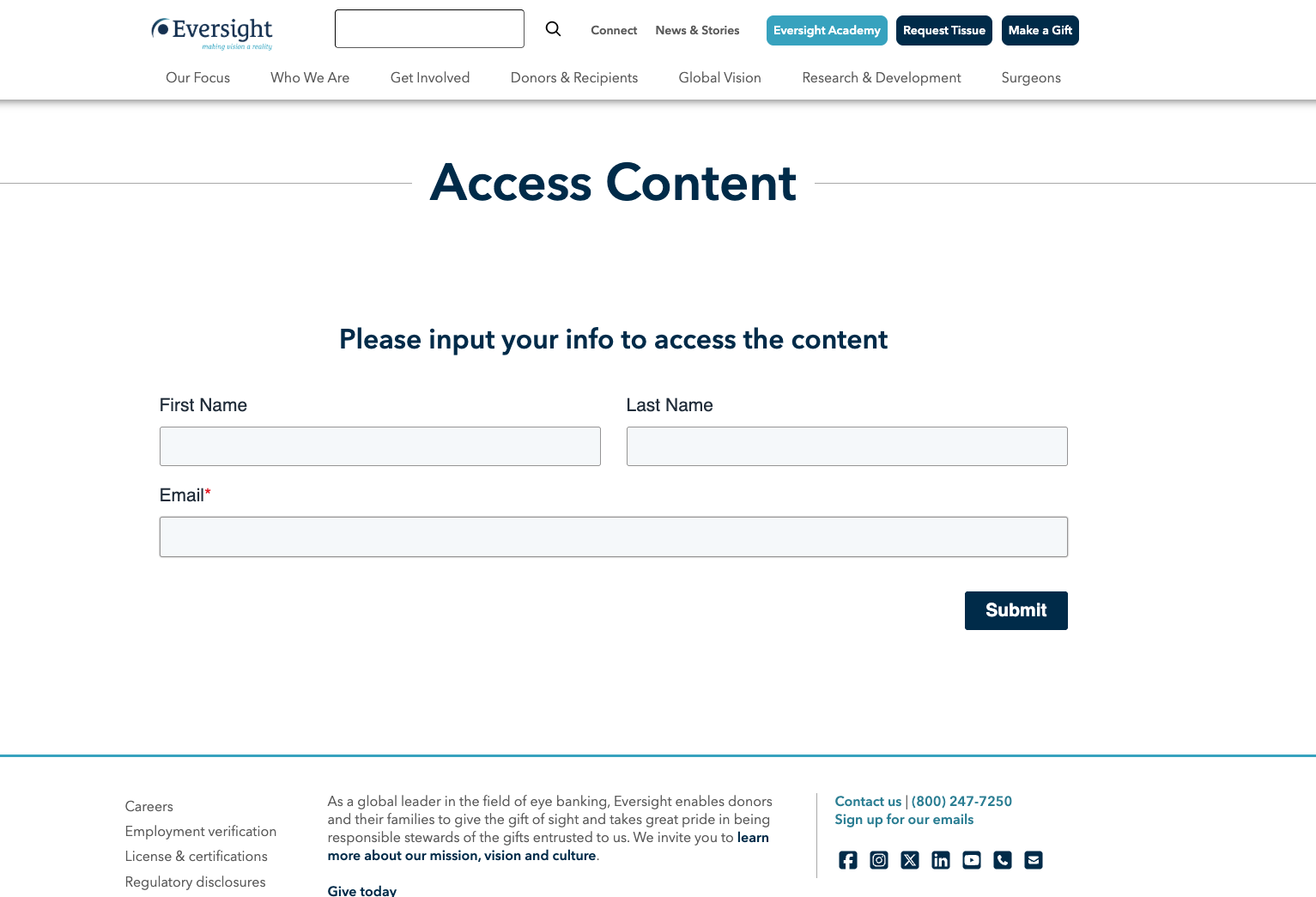
The surgical professional audience needed a different approach. Eversight wanted to gate their professional education content so the team could know who was using it and stay in touch with the clinicians returning to it. But asking a surgeon to fill out a form every time they wanted to access a webinar is the fastest way to lose a professional audience. Eversight also didn’t want to password protect the content and make it something that surgeons needed to log into, even with a magic link. There was no off-the-shelf solution for this. Lake One built a system that captures the professional's information the first time they access gated content, then remembers them on every visit after. Eversight gets to know their audience. The professionals get the frictionless return access they expect.
The donor tributes section was rebuilt with the same audience-first logic. The submission form moved from Formstack to a native HubSpot form, with media release consent captured inline rather than as a separate signature. Submitted tributes now arrive in HubSpot as draft pages, ready for the Eversight team to review and publish in a few clicks. The new tribute search was built to index the meta description field rather than the title, because tribute titles are not always consistent, but the meta descriptions can carry the names, relationships, and short narratives that visitors are actually trying to find. The result is a section that is easier for the team to collect and publish into, and easier for visitors to navigate and search.
Pillar two: a design system that tightens rather than reinvents
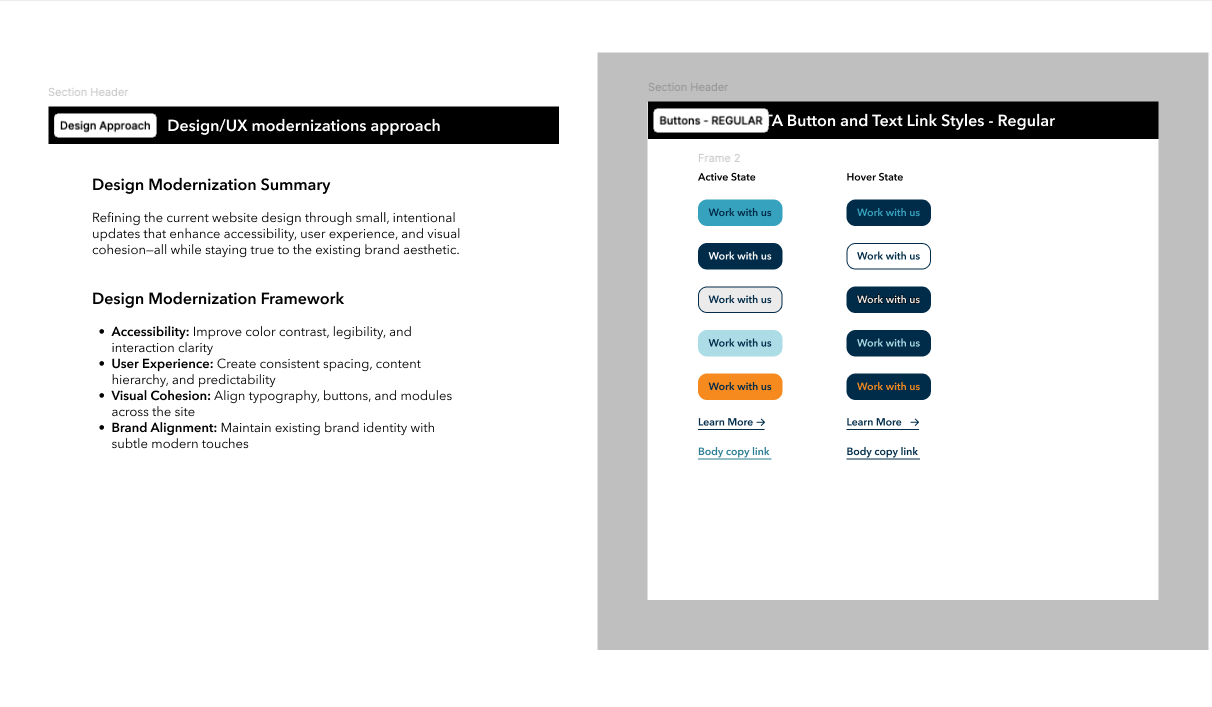
Ben Schneider, Eversight's Senior Creative and Digital Design Manager, had been holding the brand together across more than a half of a decade of incremental additions. Different program areas had picked up their own color associations. The icon library had been extended one icon at a time. Typography hierarchy was inconsistent across sections. Lake One's job was not to replace any of that. It was to tighten it.
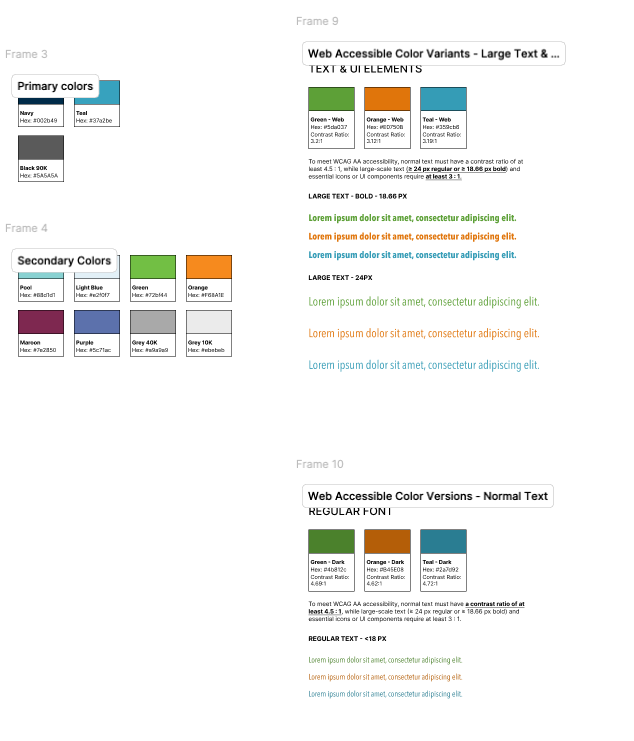
Color and contrast. Each of Eversight's primary brand colors received accessible variants tuned for web. Teal, orange, and green each have a variant 1 and a variant 2, designed for different background contexts and contrast requirements. Accessibility was treated as foundation rather than runtime patch. Color contrast, typography hierarchy, and image alt text are built into the templates. As Brenna put it during the kickoff, Eversight is an organization seeking to help people see. Accessibility was never a checklist item. It was mission alignment.
Consistent rhythm across sections. Lake One established a spacing and sizing system that lets a content editor build a new page without thinking about it. Spacing standards are set at the template level rather than per page, so new pages inherit the design system rather than recreating it. The visual rhythm holds across sections built by different people at different times.
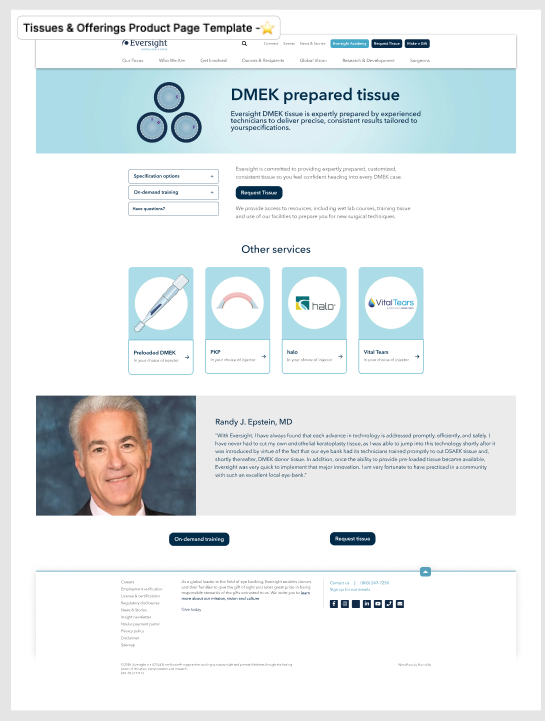
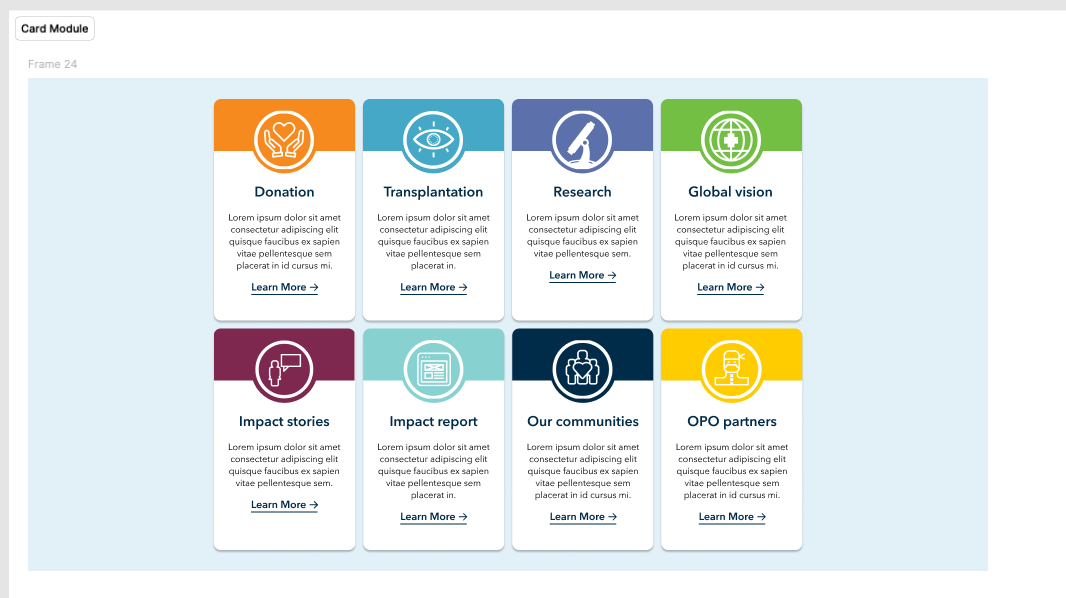
Templates and modules. Lake One delivered five clean starter templates, each starting with the right spacing and color tokens already configured. The module library was rebuilt around how Eversight's content actually behaves: a counter for impact metrics, a history timeline for organizational milestones, distinct button modules tuned for specific uses, an image module that supports the storytelling formats Eversight’s Senior Brand Strategy & Communications Specialist Caroline Miller uses every week when she interviews donor families and recipients.
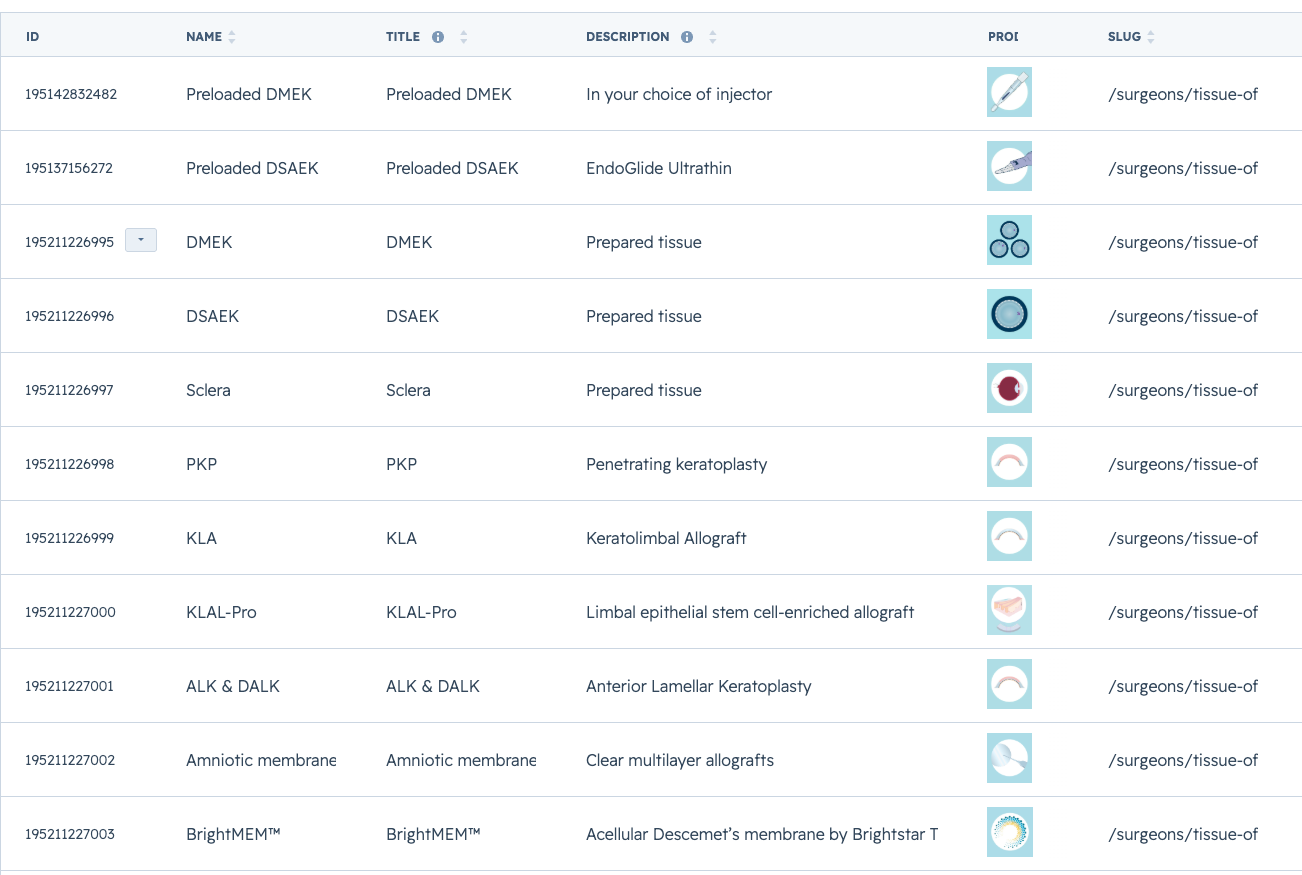
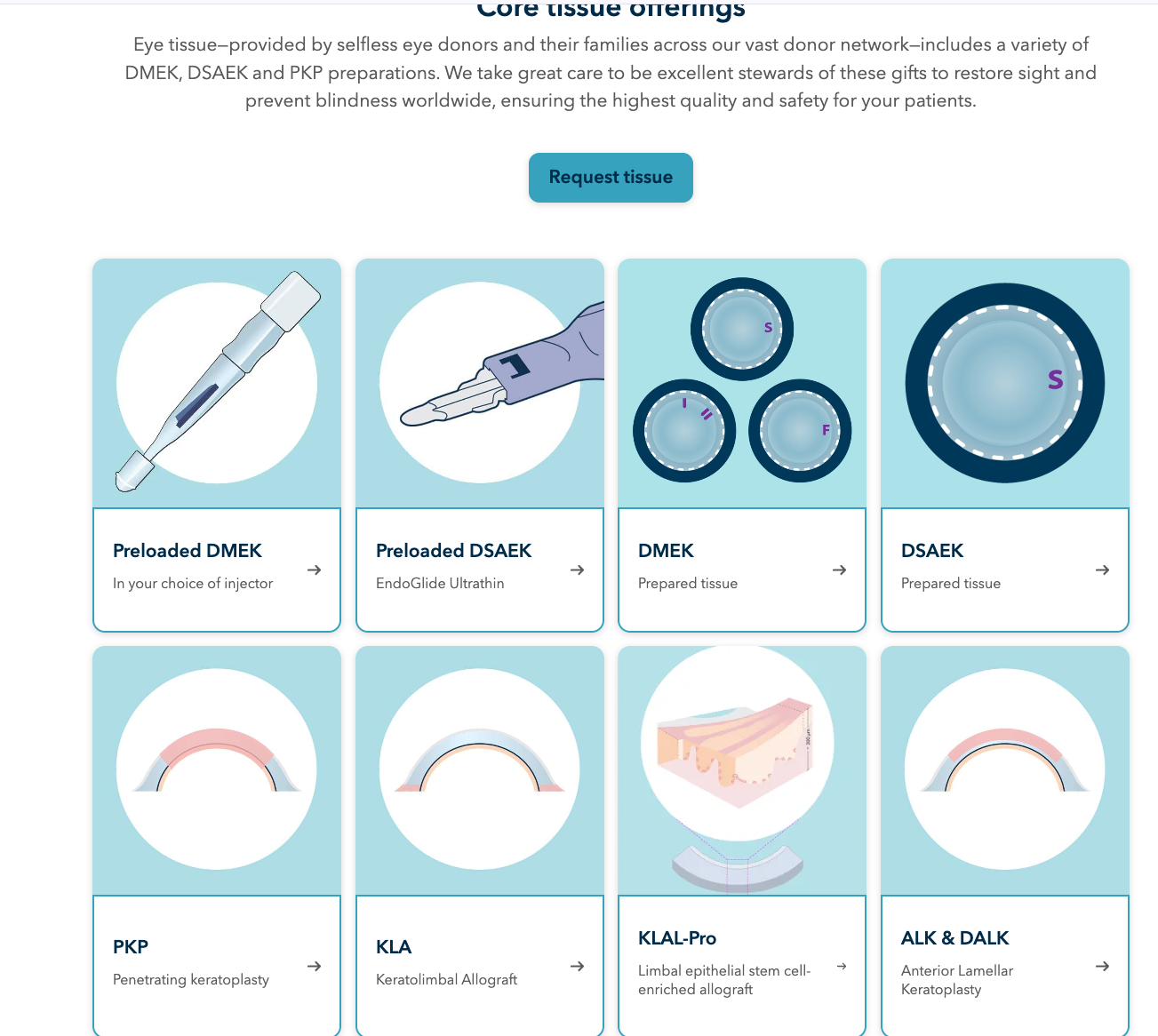
A central management layer for medical products. Eversight's tissue offerings and services, the ophthalmic products they make available to surgeons and hospitals, had been a maintenance burden in the old site. Each product had its own page. Each had its own copy that needed updating when descriptions or images changed. A name change or new product image meant editing several pages by hand and hoping nothing was missed. Lake One built a central data layer for them using HubDB, HubSpot's structured-data system. Each product is now a single row in a managed table. Updating a description, swapping a product image, or adding a new tissue type happens in one place, and the change propagates everywhere that product appears on the site. The team manages a database. Visitors see a clean front-end experience.
What the team can do now
The most important measure of a website project is not the launch. It is what the team operating the site can do the week after. Two weeks before go-live, Lake One delivered training documentation with screenshots, walked the Eversight team through it across two live sessions, and recorded both for future use.
Content staging is now part of the workflow. New pages or major edits can be built in a parallel environment, previewed on a sandbox URL, shared with internal reviewers, and published in place when approved.
Featured content on landing pages is self-serve. When Caroline wants to add a YPG-specific blog feed to the Young Physicians Group page, she can. When Ben wants to surface webinar recaps on a product page, he can. The blog tag filter section is a saved component the team can drag onto any page and configure in under a minute.
The team owns the navigation, the tributes, and the gated content library. New tributes arrive as drafts ready for review. New gated webinars and education materials drop into the existing system without an engineering ticket. The mega menu, mobile rows, and footer are editable in plain English.
Visit Eversight online to experience the site live.
What we'd tell another nonprofit thinking about this
A few things the Eversight team and the Lake One team learned together.
The first conversation matters more than the design. Most nonprofit website projects spend the kickoff on colors and fonts. The Eversight kickoff spent it on wayfinding, and the project worked because of it. Lead with how the site should behave for the audiences trying to use it.
Plan to prune more than you plan to build. Most of the SEO and findability gains came from the pruning, not the building.
Ask the technical questions early. A partner who only knows how to use HubSpot's standard import tools will struggle with WordPress sites that have years of custom theme work in them. Asking how a partner approaches API-driven migration before signing a contract is the difference between a project that ships and a project that does not.
Treat the handoff as the deliverable. The site is not done at go-live. It is done when the team running it can extend it without help.
If your organization is staring at a website that no longer reflects the mission behind it, the work is doable. It starts with the right first conversation.
More of the work.
All case studiesFrom Blackbaud to HubSpot: How World Hope International Rebuilt Their Fundraising Operations from the Ground Up
Read the case study Case study