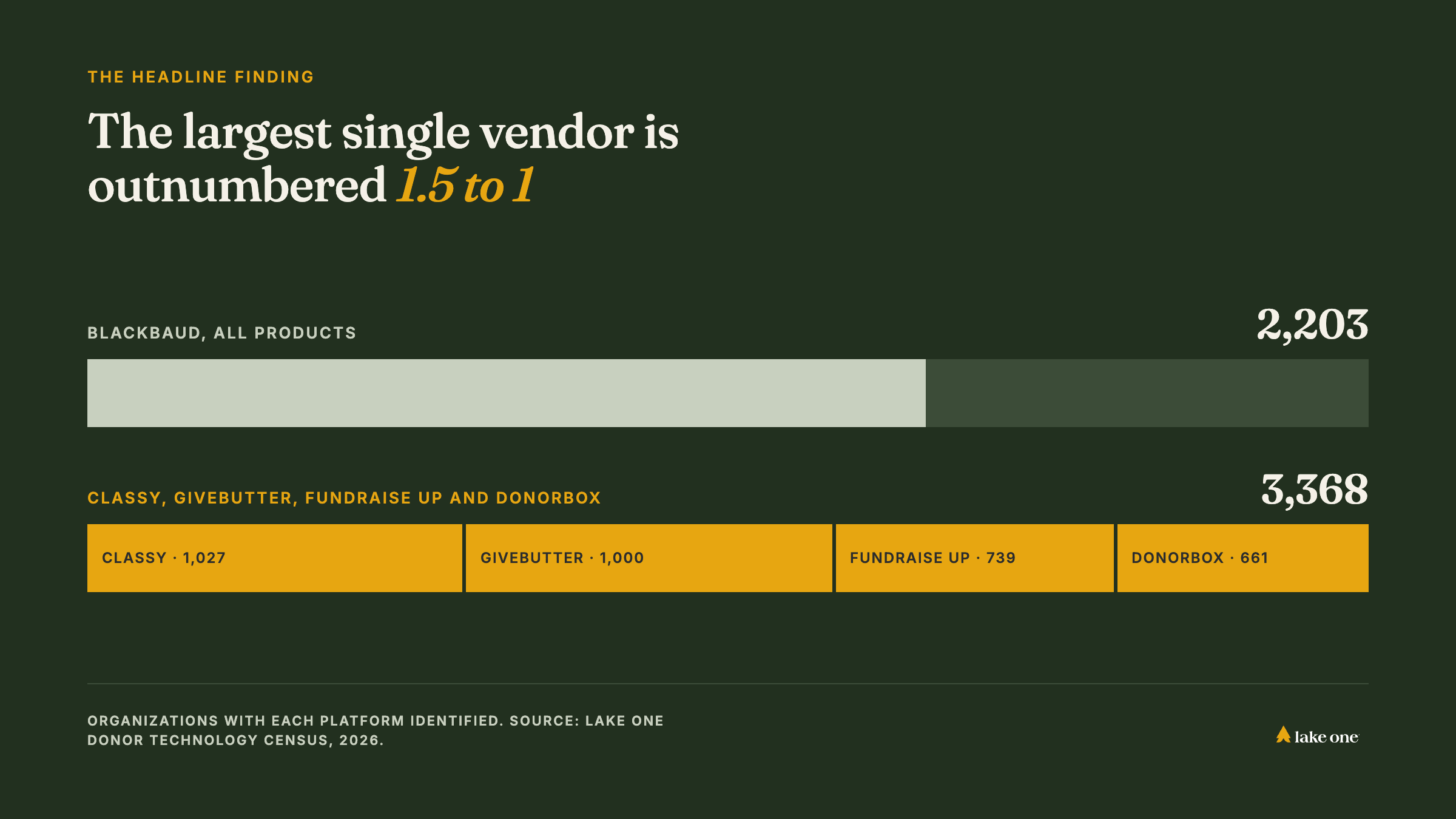
Blackbaud is still the largest single vendor on US nonprofit donation pages. It is also outnumbered. The four newest platforms in the sector, taken together, appear on 1.5 times as many organizations.
Blackbaud is still the largest single vendor on US nonprofit donation pages. It is also outnumbered. The four newest platforms in the sector, taken together, appear on 1.5 times as many organizations.
That comes from a count, not a survey. We examined the donation pages of 45,698 qualified US nonprofits and recorded the software each one actually runs.
How we counted
The universe is every US 501(c)(3) with an active exemption that clears three thresholds: $1.5M or more in annual revenue, $1M or more in contributions, and contributions at 10% or more of total revenue. Hospitals, colleges, congregations and private grantmaking foundations are excluded by sector code.
That gives 45,698 organizations, drawn from 1,964,958 records in the IRS Business Master File. Financials come from the most recent Form 990 on file, mostly fiscal year 2023.
Websites come from the address each organization reports on its own Form 990. For each site we requested the donation page, followed redirects, read the page and any embedded frames, and matched what we found against the fingerprints of 31 known platforms.
So this is a census of the online giving layer. It tells you what software takes the gift, which is not always the same as the donor database behind it. Where the platform we detect is a donor CRM's own form, as with Raiser's Edge or Bloomerang or DonorPerfect, it tells you about the CRM as well. Where it is a standalone giving platform, it does not.
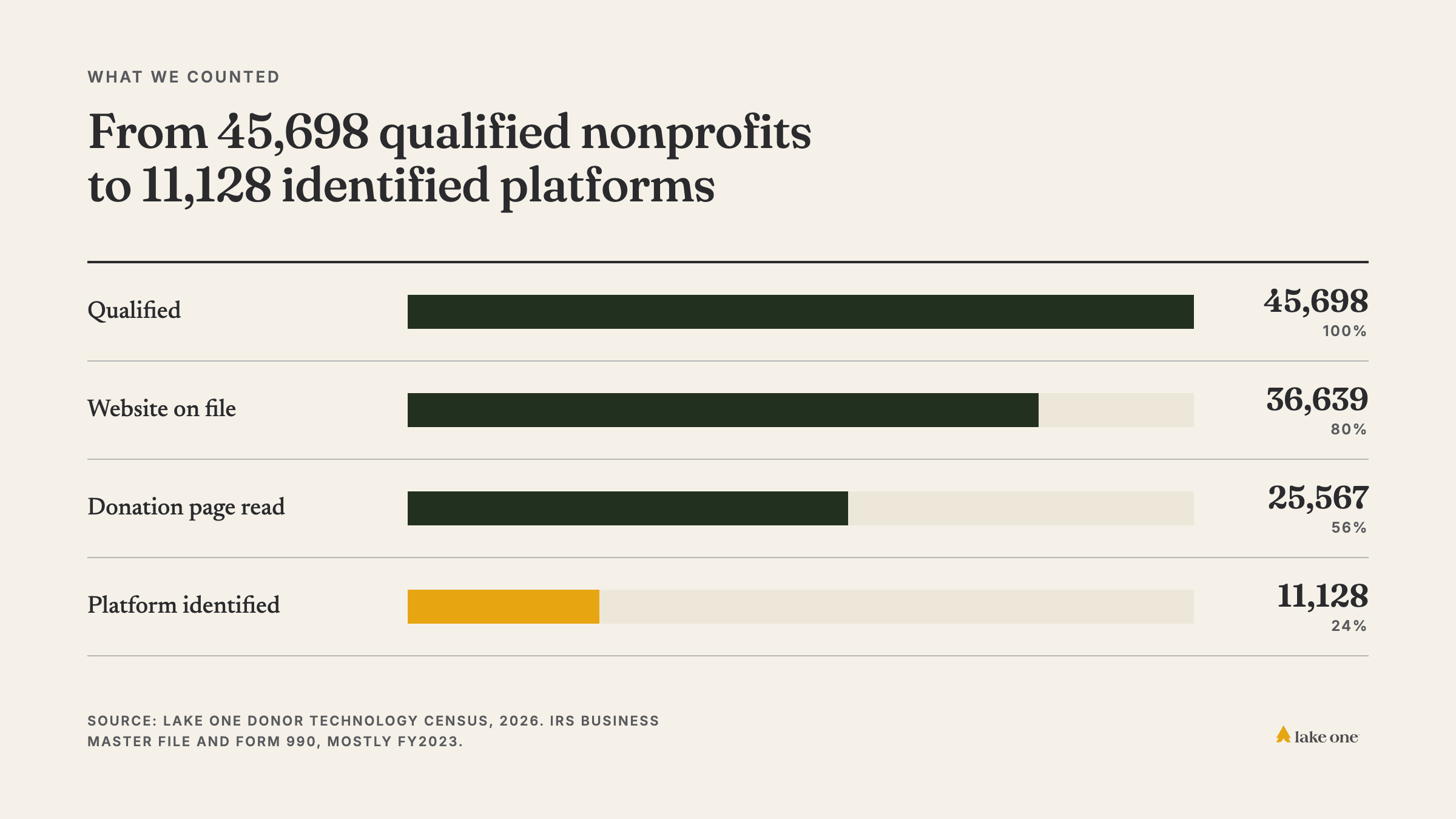 Every share below is calculated against the 11,128 organizations where we identified a platform, not against the full 45,698. No individual organization is named anywhere in this research.
The landscape
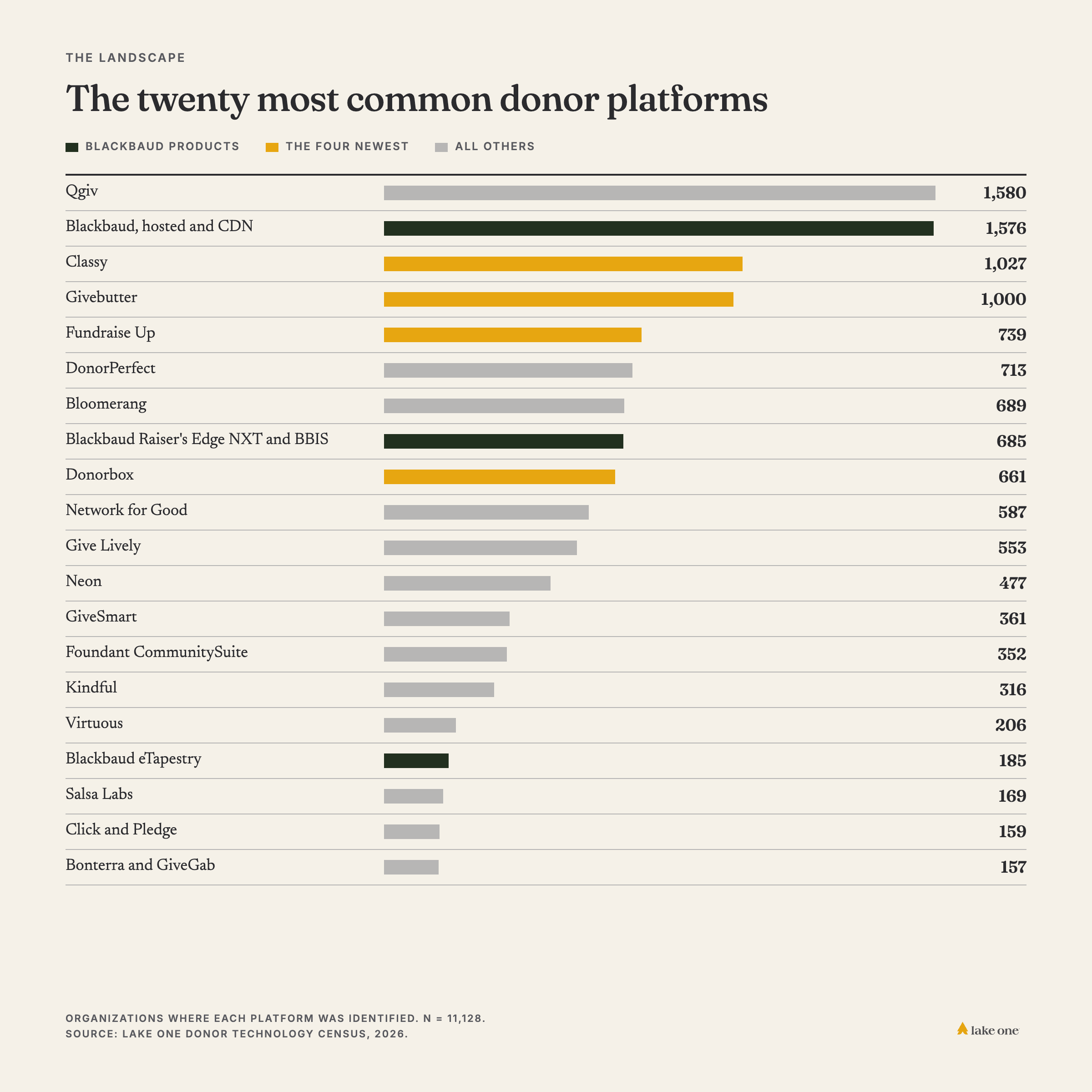
Blackbaud across all its products appears on the donation pages of 2,203 organizations, more than any other vendor. Classy, Givebutter, Fundraise Up and Donorbox together reach 3,368.
Neither figure is the sum of its rows, and the difference is worth explaining. Every count in the table is of donation pages where that platform was detected. An organization running two Blackbaud products appears in two rows, so the three Blackbaud rows above sum to 2,446 while the number of distinct organizations is 2,203. The same applies to the four newest platforms, whose rows sum to 3,427 against 3,368 distinct organizations. The vendor totals count organizations, not detections.
Qgiv is the most common donation platform
At 1,580 organizations, Qgiv appears on more donation pages than any other single platform. That is more than twice the count for Raiser's Edge NXT.
This is not a result anyone predicted, including, we suspect, Qgiv. It is a company better known for event and peer-to-peer fundraising than for being the most widely deployed giving platform among nonprofits raising over $1M a year.
The likely explanation is that Qgiv occupies a middle position the sector conversation ignores. It is not a full donor CRM and it is not a simple checkout, and organizations that need more than a payment form but less than Raiser's Edge land on it.
More than half of donation pages name no vendor
Of the 25,567 organizations whose donation page we could read, 14,439 showed no identifiable platform at all. That is 56%.
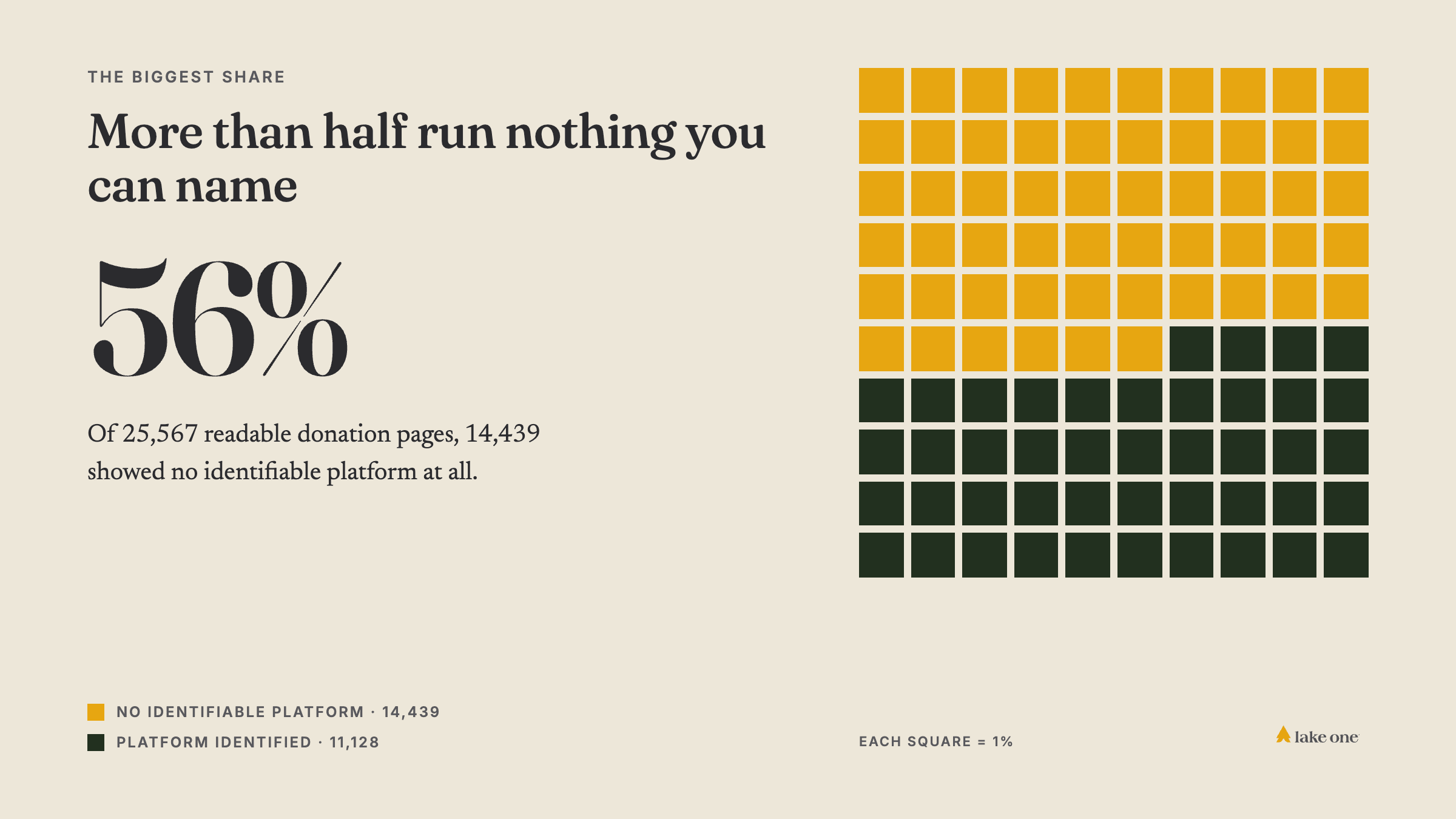
These are organizations raising at least $1M a year through a form somebody built: a Squarespace checkout, a WordPress plugin, a payment processor wired straight into the page.
There are two readings and this count cannot separate them.
Some of these organizations do have a donor CRM, but it does not touch the donation form. Gifts get keyed in afterward, by hand. That is not an absence of software. It is a gap between the giving layer and the donor database, and it is a harder problem than having no system at all.
Others genuinely run on a spreadsheet and a payment processor at over $1M in annual giving.
Either way, the sector conversation assumes every serious nonprofit has a recognizable giving platform and the only question is which one. More than half do not.
Three platforms are being retired
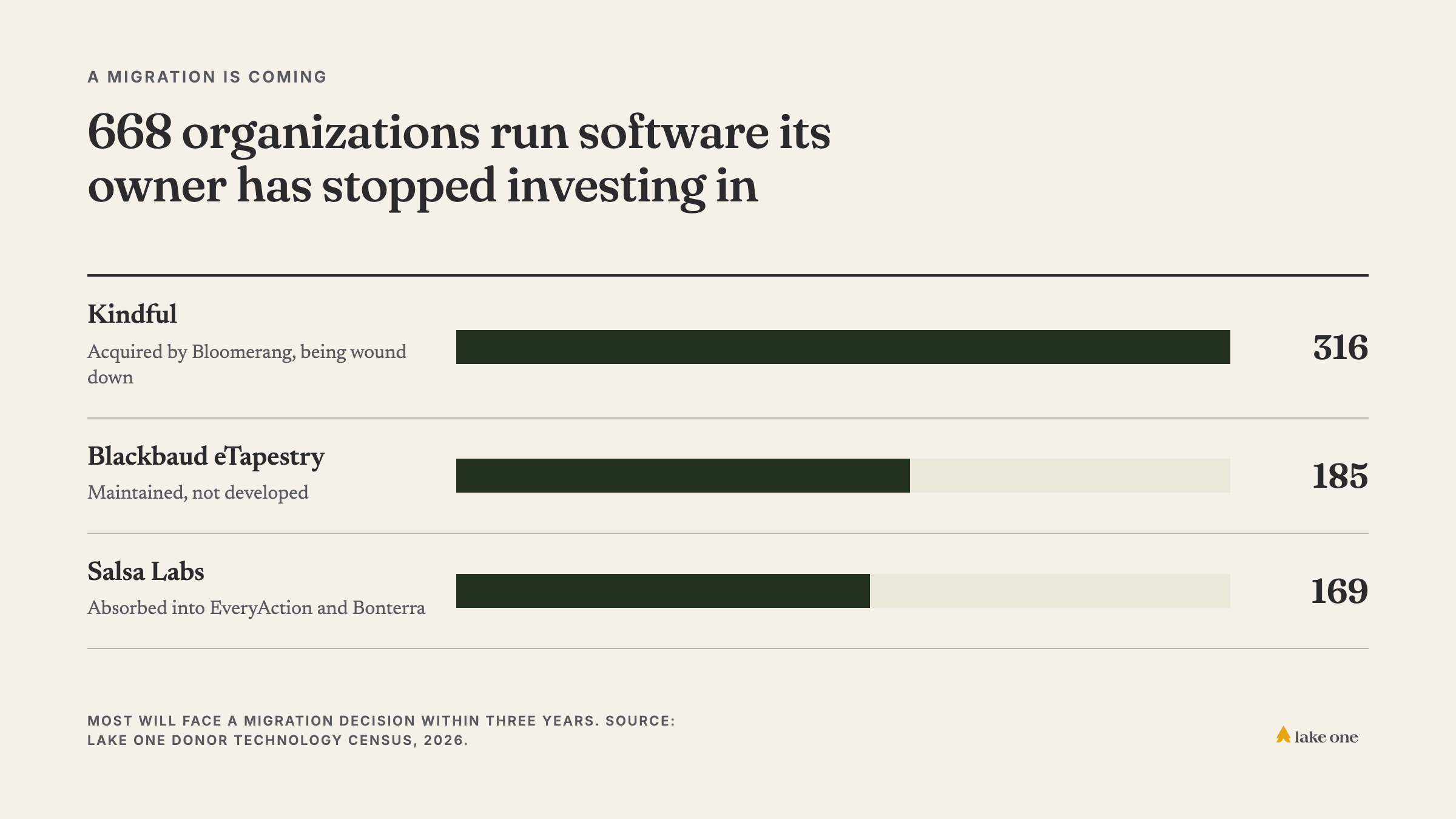
668 organizations are running software whose owner has stopped investing in it. All three of these are donor CRMs rather than standalone giving platforms, so here the donation page does tell you what the donor database is. Most of these organizations will face a migration decision within three years whether they plan for one or not. The eTapestry organizations are also counted in the Blackbaud figure above.
A fourth case deserves care rather than alarm. Salesforce stopped adding features to the Nonprofit Success Pack in March 2023 and is directing customers toward Agentforce Nonprofit. Salesforce has published no end-of-life date, and NPSP remains supported. Any consultant selling against an NPSP deadline is selling against a deadline that does not exist.
Where HubSpot sits
Lake One is a HubSpot partner. We are stating that here rather than only in the footer, because this is the section where it matters.
932 organizations run HubSpot, about 2.5% of those with a website we could resolve. That is a small number and we are publishing it because it is the number.
The overlap is more interesting than the share. We could identify a giving platform for 382 of those 932 organizations. Of those 382, 113 also run a legacy donor CRM. That is 30% of the HubSpot organizations whose stack we can see.
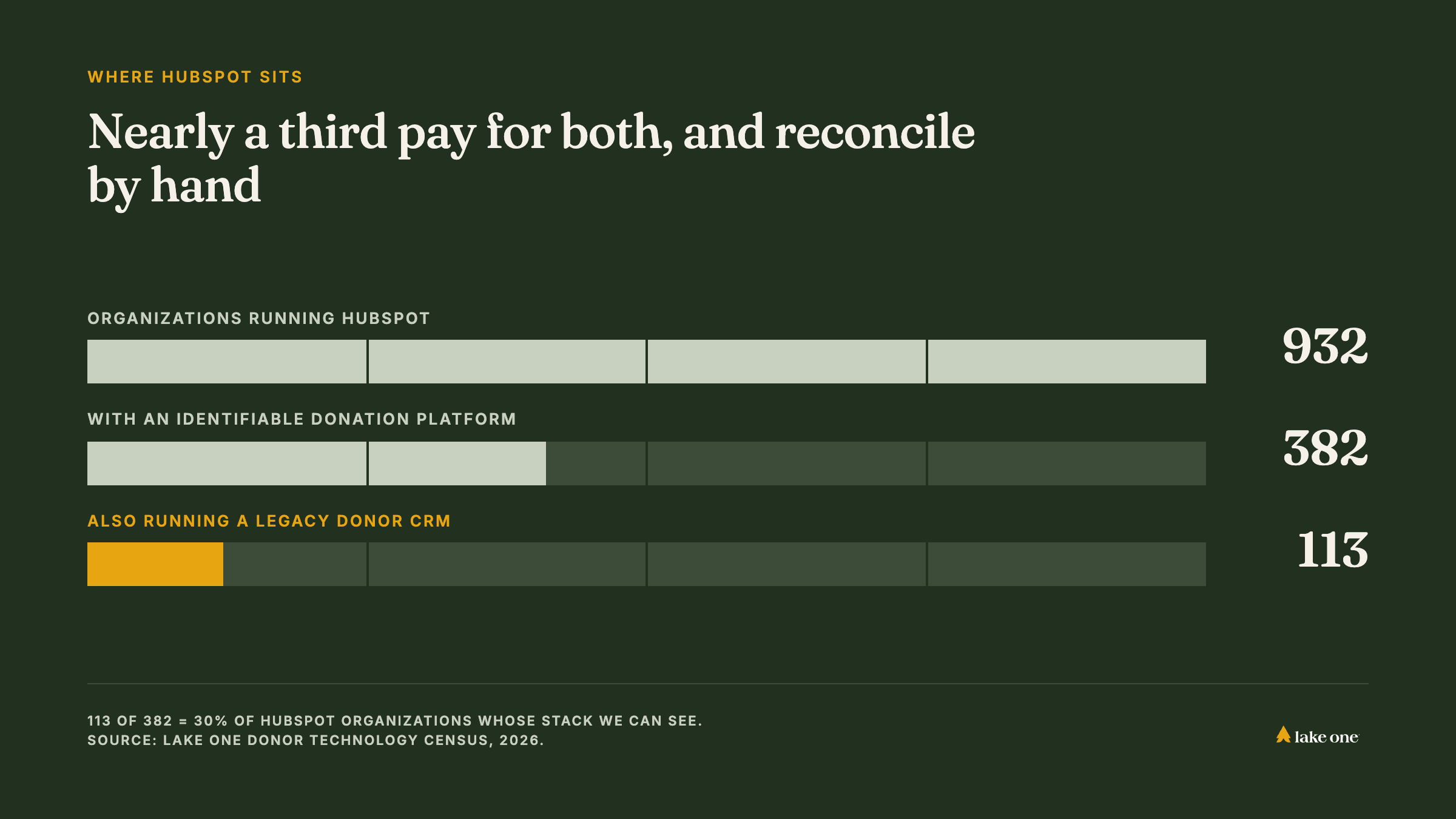
So a part of the sector is not choosing between marketing automation and a donor database. It is paying for both and reconciling between them by hand.
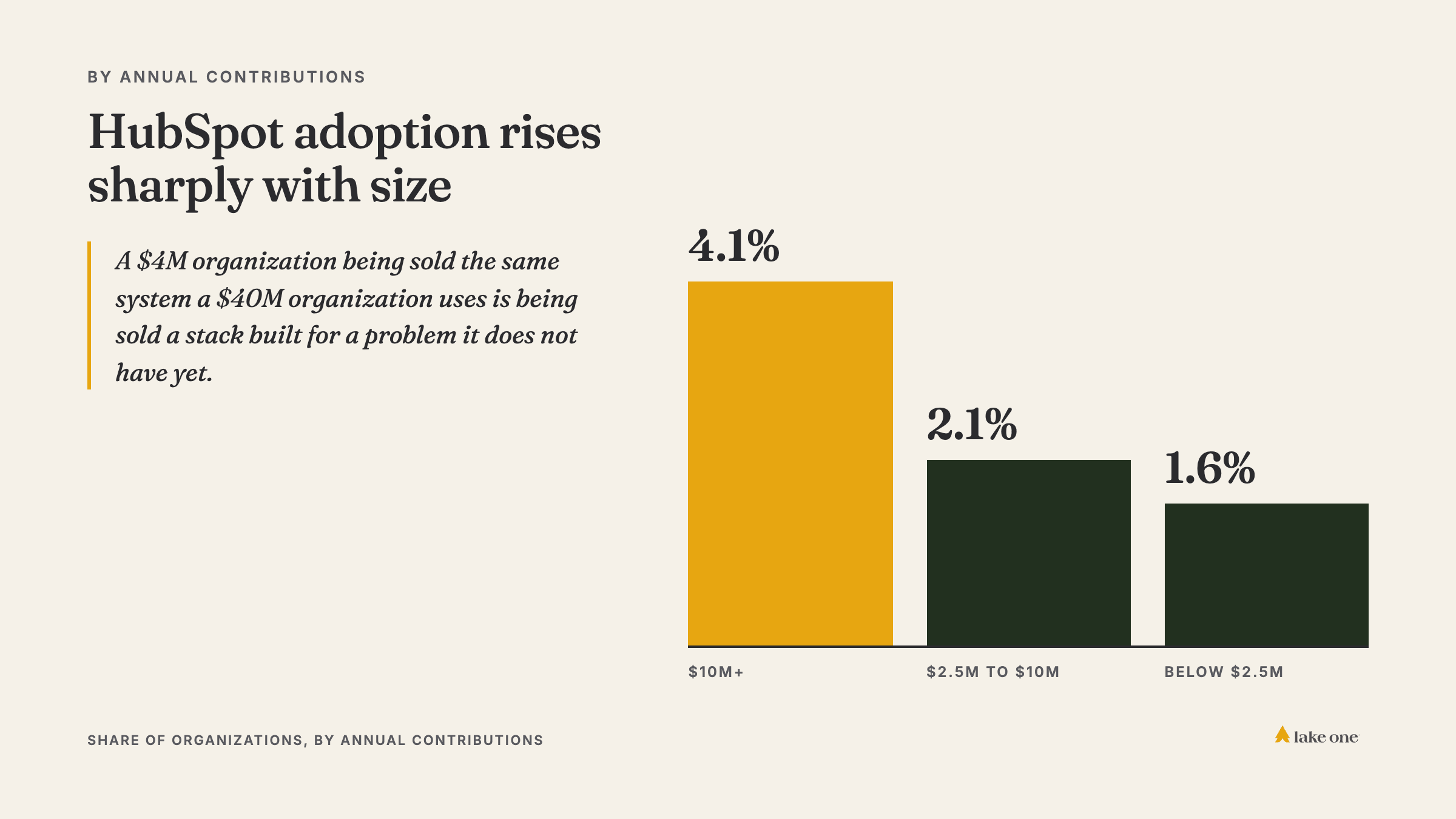
Adoption also rises sharply with organization size: 4.1% among organizations raising $10M or more in contributions, 2.1% in the $2.5M to $10M band, and 1.6% below that. That pattern is not unique to HubSpot, but it is the clearest example of it in this data.
What this count cannot see
It reads the giving layer, not the system of record. A Blackbaud form embedded on a page does not prove Raiser's Edge is the donor database behind it. An organization can run Fundraise Up forms in front of a legacy backend, or the reverse. Where the detected platform is a donor CRM's own form, the inference is stronger. Where it is a standalone giving platform, it says nothing about what sits behind it.
Forty-four percent of sites could not be read. 6,320 blocked automated requests, 3,739 had no findable donation page, 1,013 were unreachable. Larger organizations with stronger security are overrepresented among the blocked, which probably tilts this sample toward smaller organizations.
The financials are about two years old. IRS processing runs that far behind. Adequate for size bands, not for precision.
Nine thousand organizations list no website on their Form 990 and are absent from everything downstream of that step.
This is one year. A count becomes a benchmark when it is repeated. The change between editions is the finding this research cannot yet offer.
About this research
We built this count to answer a question we could not find a reliable answer to: what do comparable organizations actually use to take a gift online?
We have an obvious interest in the answer. That is why the method is published in full, why the limits are stated rather than buried, and why no figure here has been selected to make a case. The underlying aggregate tables are available on request.
This will be updated annually.